
Case study / University workflows & integration
Programme Evaluation System (PES)
Coordinating programme evaluation across people, systems and deadlines.
The original Gravity Flow workflow was developed with assistance from an external consultant. My main contributions are the Ladok and Canvas integrations, custom workflow steps and administrative dashboards, alongside ongoing technical development and refinement.
The challenge
A process with many moving parts.
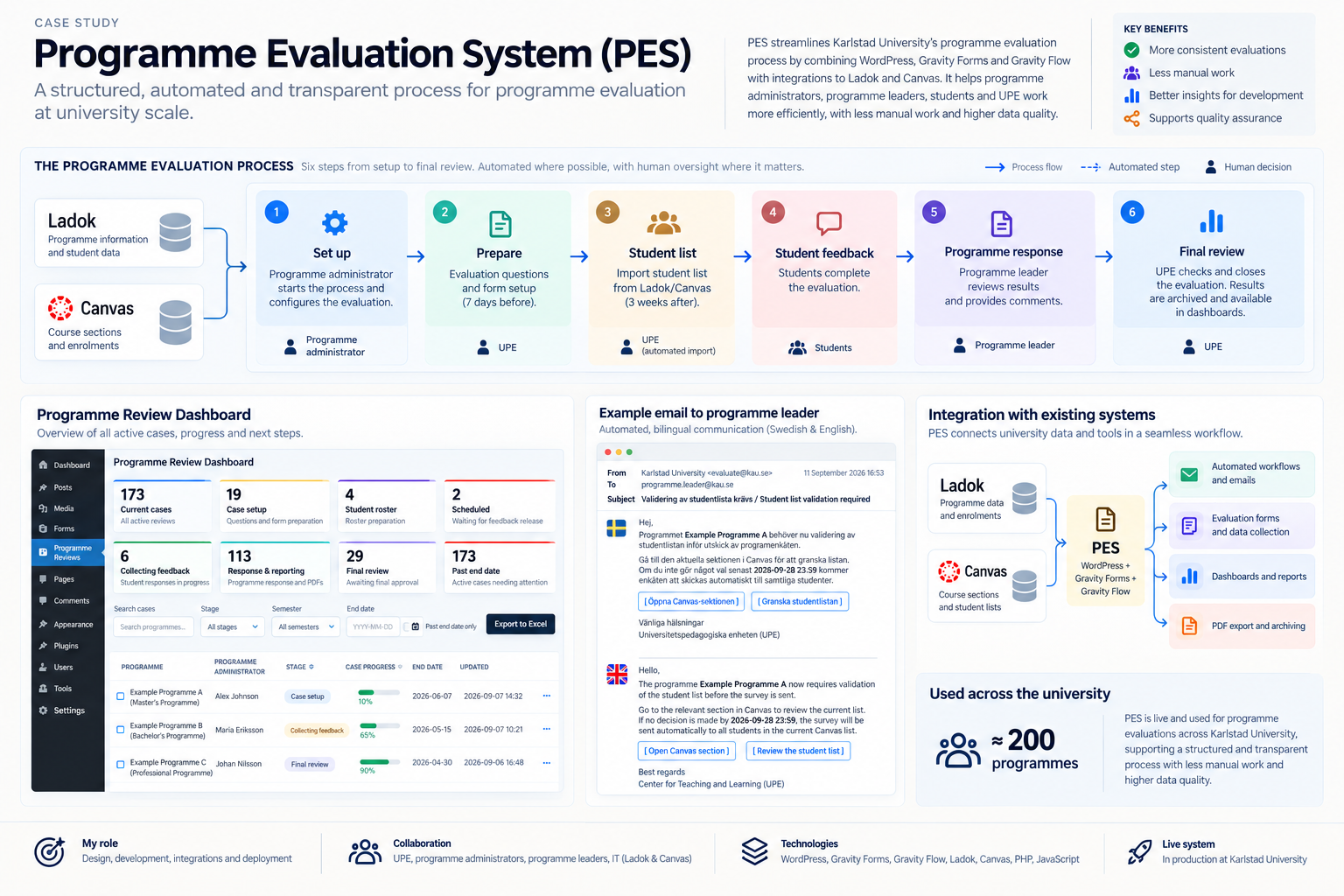
Karlstad University needed a digital system for managing programme evaluation across several roles and steps. Programme information, student participation, deadlines, responses and reviews all need to remain connected as an evaluation moves forward.
The system
One coordinated workflow.
PES coordinates those stages through one workflow. WordPress provides the application platform, Gravity Forms collects information and responses, and Gravity Flow coordinates the steps, assignments and hand-offs. Integrations connect the process to the university’s existing systems.
01 / University systems
Connecting the workflow to Ladok and Canvas.
My main technical contribution was extending the workflow into Karlstad University’s existing systems. I built API integrations with Ladok and Canvas and implemented that functionality as custom Gravity Flow workflow steps.
PES / Conceptual integration view
- Ladok & Canvas
University information and services - Custom workflow steps
API integration functionality I built - PES workflow
Information available within the evaluation process
The integrations retrieve programme information, student lists and relevant programme and role information, including programme leaders. Implementing them as workflow steps makes that information available as part of the coordinated evaluation process.
02 / Workflow automation
Automation where it helps.
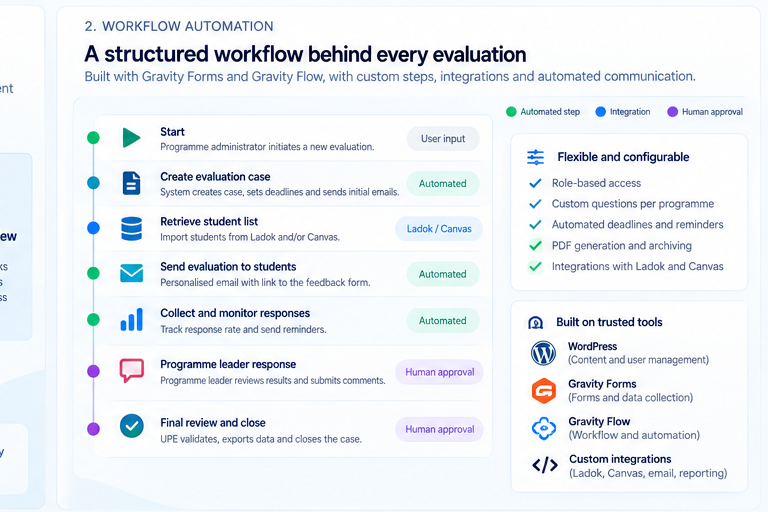
Automated emails and reminders support communication between stages. Scheduled workflow steps coordinate actions with the evaluation’s timing and deadlines.
PDF and report generation turn collected information into outputs for the review process. Custom integration steps connect these actions to the university data the workflow needs.
03 / Human oversight
Human decisions where they matter.
The workflow coordinates the work around a decision; responsibility for that decision stays with the people involved. Programme leaders review results and provide their responses. Final review and approval remain human steps.
Automated communications, scheduled actions and generated reports support these hand-offs. They sit alongside the judgement required to interpret the evaluation and complete the review.
04 / Custom administration
An administrative view across many evaluations.
The standard Gravity Flow experience was difficult for the administrators operating the process. I designed and built custom dashboards to give them an overview of evaluations, status and progress, with support for batch operations.
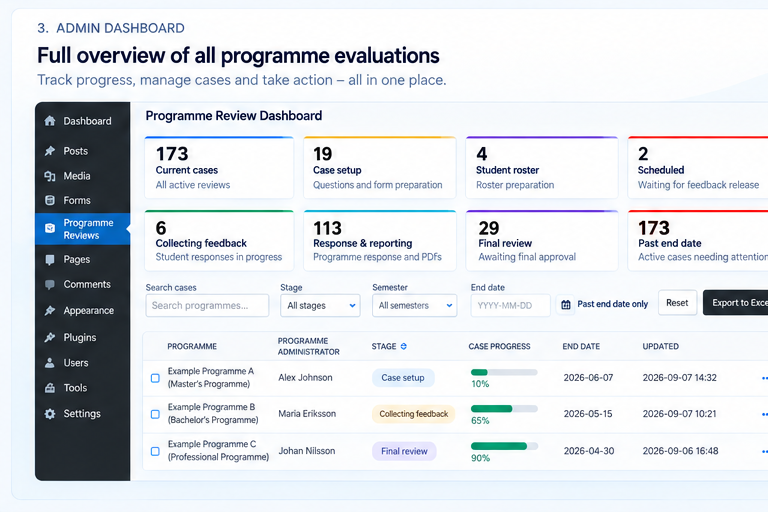
- Overview See evaluations across the different workflow stages.
- Status and progress Follow where cases are in the process.
- Batch operations Support administrative actions across multiple cases.
05 / Evaluation journey
From setup to final review.
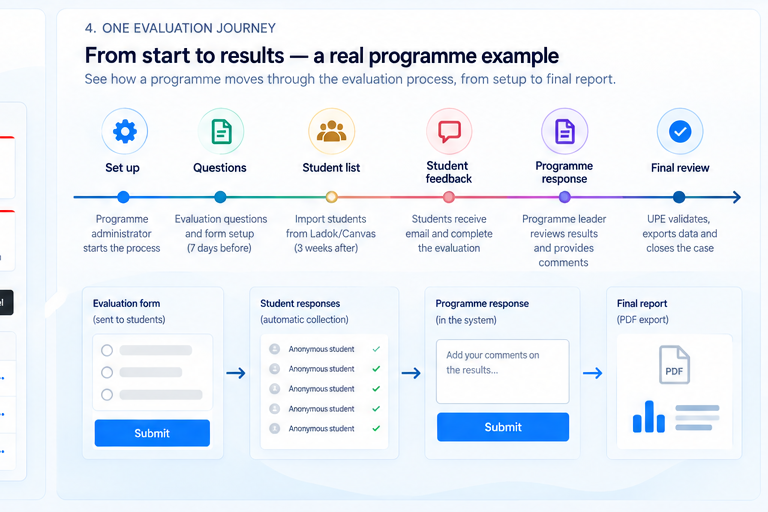
An evaluation moves through setup, preparation of questions, student-list retrieval, student feedback, programme response and final review. Forms, integrations and reports support that journey as responsibility passes between participants.
Use and continued development
Used across ≈200 university programmes.
Used across approximately 200 university programmes.
My work continues through development and refinement of the integrations, custom workflow steps and administrative tools.